A sunrise hike is a fundamentally different experience from the same trail at noon. The parking lot is empty. The trail is silent. You’re climbing by headlamp through dark forest, and then somewhere near the summit the sky goes from black to deep blue to pink to gold and suddenly you can see fifty miles. The hikers who do this regularly — the ones who set 4 AM alarms voluntarily — aren’t doing it for exercise. They’re doing it because a summit sunrise is the single most memorable thing you can experience on a trail.
These are the East Coast summits where sunrise is worth losing sleep over.
Is Cadillac Mountain Really the First Sunrise in the US?
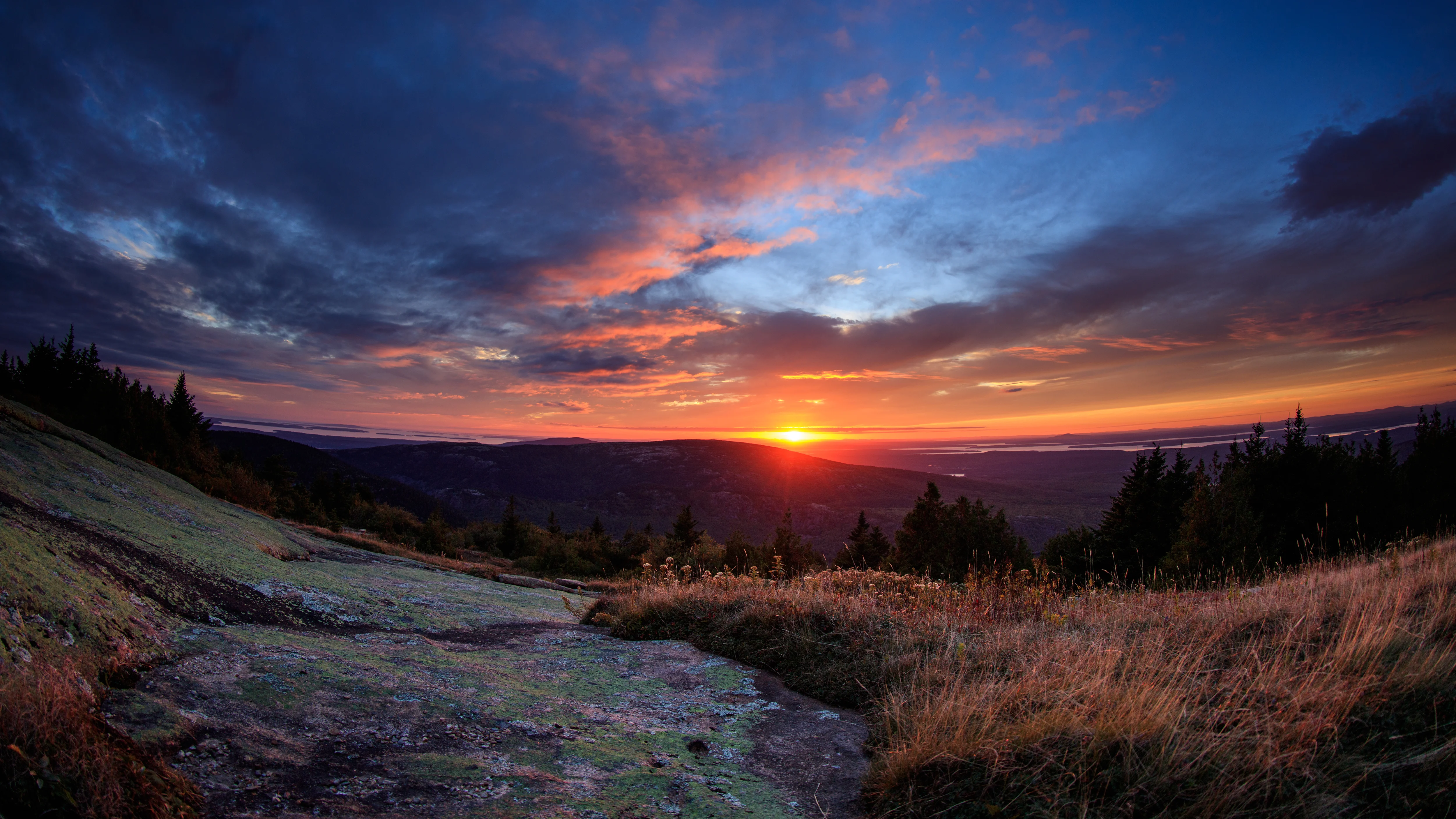
From early October through early March, yes. Cadillac Mountain at 1,530 feet is the highest point on the Atlantic coast, and during those months the angle of Earth’s rotation makes it the first place in the United States to see the sun rise over the ocean.
You can drive to the summit, and most people do. But the South Ridge Trail (7 miles round trip, 1,530 ft gain) is the way to earn it. Start around 3:30-4 AM depending on season. The lower trail is forested and dark. The upper mile opens to exposed granite slabs marked by cairns. You arrive at the summit in the pre-dawn blue light, find a rock to sit on, and wait. The Atlantic stretches east to the horizon. The Porcupine Islands float in Frenchman Bay below. And then the sun comes up.
One hiker who avoided the Cadillac crowds by hiking Gorham Mountain instead described starting at 4:40 AM: “Very doable in the dark with headlamps. Found a clearing a little before the summit. We were the only ones up there for a while, we spent some time stargazing.” That’s the alternative if you want the Acadia sunrise without the Cadillac crowd.
Pro tip: Vehicle reservations are required to drive to the Cadillac summit from late May through October. Hiking up avoids this entirely. Summit temperatures can be 20-30 degrees colder than Bar Harbor with significant wind — bring real layers and a hot drink.
What Are the Best Sunrise Hikes in the Adirondacks?
Cascade Mountain (4.8 miles round trip, 1,940 ft gain) is the most popular of the Adirondack 46 High Peaks — and for good reason, it has the best summit view in the range relative to effort. Multiple hikers report starting at 4 AM: “We started the hike at 4am and made it up just in time to catch the sunrise! We did Cascade first and hung out there for a good while.” The 360-degree summit panorama looking across the Great Range at dawn is spectacular.
Giant Mountain (8.5 miles, 4,436 ft gain) is the harder alternative for experienced hikers who want a quieter summit. The exposed upper ridge faces east — perfect sunrise orientation. Start by 3 AM for this one. You’ll need a headlamp for at least 2 hours of climbing in the dark.
Pro tip: Adirondack High Peaks trailhead parking fills by 7 AM on summer weekends. Starting for sunrise means you get the best parking AND the best light. Double win.
Where Is the Best Sunrise Spot on the Appalachian Trail?
McAfee Knob in Virginia (8.8 miles round trip, 1,740 ft gain) is the most photographed point on the entire Appalachian Trail — the iconic rock ledge extending over the Catawba Valley. It faces east. Sunrise here is the signature Virginia hiking experience.
AllTrails reviewers who’ve done it at dawn are emphatic. One hiked up in the dark: “We got to the parking lot at 6:30 AM, and there were a lot of parking spaces open! We caught a gorgeous sunrise at 6:52 AM!” Another: “Started the hike counter clockwise in the early morning and the switchbacks in constant incline help to warm up all the way to the Shockeys Knob shelter.”
The trail is well-maintained AT — no scrambling, no route-finding issues, just steady climbing on a well-blazed path. The approach works perfectly by headlamp.
Annapolis Rock in Maryland (5.4 miles round trip) is the closest AT sunrise option to DC — 90 minutes by car. The broad rock outcrop faces west (sunset is better), but the morning light on the Greenbrier Valley below is still worth the early start for the solitude alone.
Can You Catch Sunrise at the Delaware Water Gap?

Mount Tammany (4.3 miles, 1,193 ft gain) faces east over the Delaware River — a natural sunrise amphitheater. Hikers who’ve done it confirm: “I went at 6am to catch the sunrise at around 7am. Bring a headlamp and flashlight — it was not bad but it’s steep and rocky.” Another: “Did the trail for sunrise and it did not disappoint.”
The Red Dot Trail is steep enough that you’re working hard on the climb, which keeps you warm in the pre-dawn cold. The clifftop view 1,200 feet above the river catches first light beautifully. An hour from Philadelphia, about 75 minutes from NYC.
What About Sunrise Hikes in the Catskills?
Giant Ledge (4 miles, 1,400 ft gain) is the best Catskills sunrise option. The open rock ledges face south, catching the early light across the full Catskill escarpment. One reviewer recommended it simply: “Go early for the sunrise… was a great view.” The trail is rooty but straightforward by headlamp.
Overlook Mountain fire tower (4.9 miles, 1,400 ft gain) offers a 360-degree platform — sunrise in every direction. The wide gravel road is the easiest pre-dawn trail on this list. No scrambling, no route-finding, just steady uphill on a road you can’t lose in the dark.
Pro tip: Catskills sunrise times vary dramatically by season — from 5:25 AM in late June to 7:15 AM in late December. Check exact times and plan backward from summit time.
Are There Good Sunrise Hikes in New England Beyond Acadia?
Mount Norwottuck in western Massachusetts (3.6 miles, moderate) has east-facing views. Multiple hikers report dawn summits: “Summited at 5am and watched the sunrise — overall was a good hike.” Another: “Awesome sunrise run! Loved catching the sunrise then heading down.” Short enough to summit, watch sunrise, and be at work by 9.
Mount Monadnock in southern New Hampshire (3.6 miles, moderate) — the bald summit gives 360-degree views across New England. Two hours from Boston. The White Dot Trail is the most direct route and well-suited for headlamp hiking. One of the most climbed mountains in North America, but sunrise hour gives you the summit nearly alone.
How Do the Best Sunrise Hikes Compare?
| Summit | Miles RT | Elev. Gain | State | Faces | Start Time |
|---|---|---|---|---|---|
| Mount Norwottuck | 3.6 | ~700 ft | MA | East | 90 min before sunrise |
| Mount Monadnock | 3.6 | 1,700 ft | NH | 360° | 2 hrs before |
| Giant Ledge | 4.0 | 1,400 ft | NY | South | 2 hrs before |
| Mount Tammany | 4.3 | 1,193 ft | NJ | East | 90 min before |
| Cascade Mountain | 4.8 | 1,940 ft | NY | 360° | 2.5 hrs before |
| Overlook Mtn (tower) | 4.9 | 1,400 ft | NY | 360° | 2.5 hrs before |
| Annapolis Rock | 5.4 | ~500 ft | MD | West | 2 hrs before |
| Cadillac Mountain | 7.0 | 1,530 ft | ME | East (ocean) | 3 hrs before |
| Giant Mountain | 8.5 | 4,436 ft | NY | East | 3.5 hrs before |
| McAfee Knob | 8.8 | 1,740 ft | VA | East | 3 hrs before |
What Should I Know About Sunrise Hiking?
You will hike in the dark. This is non-negotiable. Bring a headlamp with fresh batteries and a backup light source. Test your headlamp before leaving the car. A dead headlamp at 4 AM on a mountain trail is a genuine problem.
Summit temperatures at dawn are brutal. Even in summer, pre-dawn summit temperatures can be 30-40 degrees colder than the valley with wind chill. Bring a puffy jacket, gloves, and a hat even in July. A hot drink in a thermos is the difference between enjoying the sunrise and enduring it.
Plan backward from sunrise time. Check the exact sunrise time for your date and location. Add 20-30 minutes of buffer. Then calculate how long the trail takes you and add 15 minutes for hiking slower in the dark. If sunrise is at 6:45 and the trail takes 2 hours, leave the car at 4:00.
Download your map before driving. Cell service is nonexistent at most trailheads at 3 AM. Pre-download your AllTrails map or GPX track. Cairns and blazes are harder to follow by headlamp — having GPS navigation prevents wrong turns that cost you the sunrise.
The parking advantage is real. Multiple hikers across every trail on this list mention the same thing: the lot was empty when they arrived for sunrise, full by mid-morning. Starting early solves the two biggest problems on popular East Coast trails — parking and crowds — simultaneously.
Cloud cover happens. Check weather before committing to a 3 AM alarm. A cloudy sunrise isn’t worth the sleep deprivation. Clear skies or broken clouds are ideal. Full overcast means you’re just cold in the dark for no payoff. Mountain-specific forecasts (not valley forecasts) are what matter.